

This essay covers a lot of ground. From a Minneapolis traffic jam and a century-old lie about who's really in the way, and a Daoist tradition of universal compassion converge on a single question: what does it cost us, individually and collectively, when we redesign our systems around the comfort of power rather than the dignity of the people caught beneath it? This essay traces a line from a scripture about an archetypal savior who cannot stop listening to the world's cries, through a philosopher who dared to read the Daode jing as an act of universal salvation, through the Quanzhen ancestors who turned that theology into famine relief and mutual aid, to a single sentence that once stopped a Mongol emperor mid-slaughter—and asks what that same sentence, spoken now, would have to sound like.
Driving through downtown Minneapolis this morning, taking one of my daughters to her theater camp, traffic was held up a couple of times near the Convention Center by jaywalkers. I don’t know what it is about that stretch of road, but on most days the traffic there gets stopped by people crossing where and when they aren’t supposed to. They may have been half lost, trying to find their way to a good place to park and then navigating the urban canyons of glass and steel (not to mention skyways) and find their way to where they need to be, the convention center presumably, a place they may be finding for the first time. My daughter, annoyed that we were running late, suggested I honk. I declined—nothing good comes of a car horn aimed at a person on foot—but it got us talking about where jaywalking actually came from, as an idea and as a crime, and about the strange asymmetry in how we respond to it depending on which side of the windshield we happen to find ourselves on.
It turns out jaywalking is not, as I’d always half-assumed, an ancient feature of how roads work. It was manufactured. Before the automobile, city streets belonged to pedestrians outright. Vendors worked from the middle of them, children played in them, and when cars started killing people in large numbers (more than 200,000 Americans in the 1920s alone), the public response, properly so, was fury at the cars and their drivers. “Jay-driver” was the original insult, aimed at the reckless motorist, a “jay” being period slang for a rube who didn’t know the rules of the road. It was the auto industry, not any organic shift in common sense, that spent the 1920s reversing that insult onto pedestrians instead, funding “safety councils,” staging ridicule campaigns, and lobbying city after city (Kansas City first, in 1912; Los Angeles, the model that stuck, in 1925) to criminalize the simple act of crossing a street where a person judged it safe to cross. The historian who’s documented this most carefully, Peter Norton, put the mechanism plainly: in the early days of the automobile, it was the driver’s job to avoid the pedestrian, and only afterward did an entire culture get engineered to reverse whose fault it was when a person got hit. Currently we seemed to have reached a more reasonable middle ground, where jaywalking is (mostly) merely frowned upon, and drivers are expected not to run people down.

Our chat in the car got me thinking about how that’s not really a story about traffic laws. It’s a story about what a system decides to name as the obstacle to its own smooth operation, and what that says about the system itself, and the people who design and perpetuate it. The cars didn’t get safer. The streets didn’t get redesigned around the bodies already using them. Instead, an enormous and well-funded effort went into convincing everyone that the people (who were already there) were causing the friction in the machine, that their presence, their unpredictable, slower, and more vulnerable movement through space was the problem to be solved, rather than a fact to be built around. That’s something we can see everywhere in our systems. It’s there in how a city polices the person sleeping in a doorway as a nuisance to the smooth flow of commerce rather than a person failed by the community. It’s there, at a much larger and bloodier scale, in how the maintenance of a political and military order gets treated as the given, and the people living under its checkpoints and its bombs get treated as the disruption to it, which is a great deal of what I hear underneath the language used (or refused) for what’s happening right now in Gaza and the West Bank. And much like the pedestrians who came to be labeled as jaywalkers or troublemakers, the people of Gaza and the West Bank were there first, simply going about their lives, before a system was created which saw them as a nuisance or an obstacle at best, and as disposable at worst. Different scales, the same original sin: a system that exists to keep something else moving smoothly has decided that living, breathing, unpredictable life is the thing in its way. This is obviously unsustainable. We find ourselves at a fork in the road.
Joanna Macy, the Buddhist scholar and systems theorist who died last year, spent five decades naming exactly this fork before it became a headline. She called the version we’re living through the Great Turning—a pivot point between what she named the Industrial Growth Society and a life-sustaining civilization, and she was direct about what distinguishes the two: one measures its own success by how fast it can extract material from the Earth and convert it into products, weapons, and waste, while the other measures success by whether life itself—human and more-than-human—is actually being sustained by what the system does. The jaywalker, the person sleeping rough, the family behind a checkpoint, each one is what happens when a system built on the first logic runs into a living breathing body it was never designed to value and solves the resulting friction by blaming the body instead of redesigning the system.
Macy didn’t think this Turning happens by insight alone or arrives as some ambient shift in the weather of the culture. She described it as requiring three kinds of work at once—the holding actions that physically slow the damage, the patient building of life-sustaining structures to replace what’s failing, and a genuine shift in the underlying sense of what a self even is, away from the illusion of separateness and toward what her own Buddhist training taught her was always true—that we are woven into the same living system as the jaywalker, the unhoused man, the family in Rafah, and the species going extinct without a name most of us will never learn. And she refused to treat grief over any of this as a failure of the work. Grief, she insisted, is simply what love feels like when it meets loss. This is evidence the connection was real, not a sign it should be gotten over. That reframing matters more to what follows here than it might first seem; a tradition built entirely around a figure who cannot stop hearing the world’s cries has, I think, always known this too.
I want to follow that same fork—the choice between systems built to extract from life and systems built to sustain it—into a much older set of traditions than any traffic ordinance, because I don’t think the question is new, even if Macy gave our own moment a good name for it. It runs from a scripture, to a philosophy, to a school of practice, to a single afternoon in Central Asia in 1222 when an old man on a government horse tried to stop an empire from killing, and from there back to now—to this year, to the wars and starvations and expulsions that are the present occasion for asking what any of this contemplative inheritance was ever actually for.
There is a scripture that begins in heaven and ends with a sound. In the Taiyi Jiuku Hushen Miaojing, Lord Lao (aka Laozi, legengary author of the Daode Jing) rises from his jade throne and walks before Yuanshi Tianzun, the Celestial Worthy of the Primal Beginning, to make a petition. He has seen, he says—in the Three Realms, in the Sea of Misery, numberless beings meeting harshly with distress, entangled in nets of suffering and swarms of passion, from which escape is difficult. He wants to wield his own light and go down into it to help the suffering beings. The Celestial Worthy stops him. You need not go yourself, he says. There is already one who does this.
In the Eastern World of Vast Delight, there dwells someone great, compassionate, and humane—the Celestial Worthy of Great Oneness, Savior from Sorrow, taking as many forms as there are grains of sand, constantly heeding the cries of beings, whether in the heavenly palace or the human realm, among the damned or among sages, wherever a cry is raised. And how is he summoned? Not by rite, not by lineage, not by merit accumulated over countless eons. Raise your voice, the Celestial Worthy tells Lord Lao, cry the name of Great Oneness, and he will surely answer.
The one who hears
Taiyi Jiuku Tianzun has no single origin. He is a composite of an ancient stellar sovereign, Taiyi, the pole-star ruler known already in the Shiji, with the Lingbao salvation literature’s need for an active, personal agent of rescue, and by the middle of the Tang dynasty he had absorbed, quite openly, the iconography of Guanyin (herself a composite of the formerly male Indian bodhisattva Avalokitesvara and the Chinese female goddess Guanyin)—the willow branch, the vase of pure water, the lion in place of Guanyin’s lotus throne. Christine Mollier, who has done the patient work of dating the Taiyi jiuku hushen miaojing, reads it not as plagiarism of the Lotus Sūtra’s Universal Gate chapter which features Avalokiteshvara, but as a Daoist transposition, a scripture that took the shape of the bodhisattva of compassion and rebuilt it in Daoist materials, because the shape itself had proven necessary.
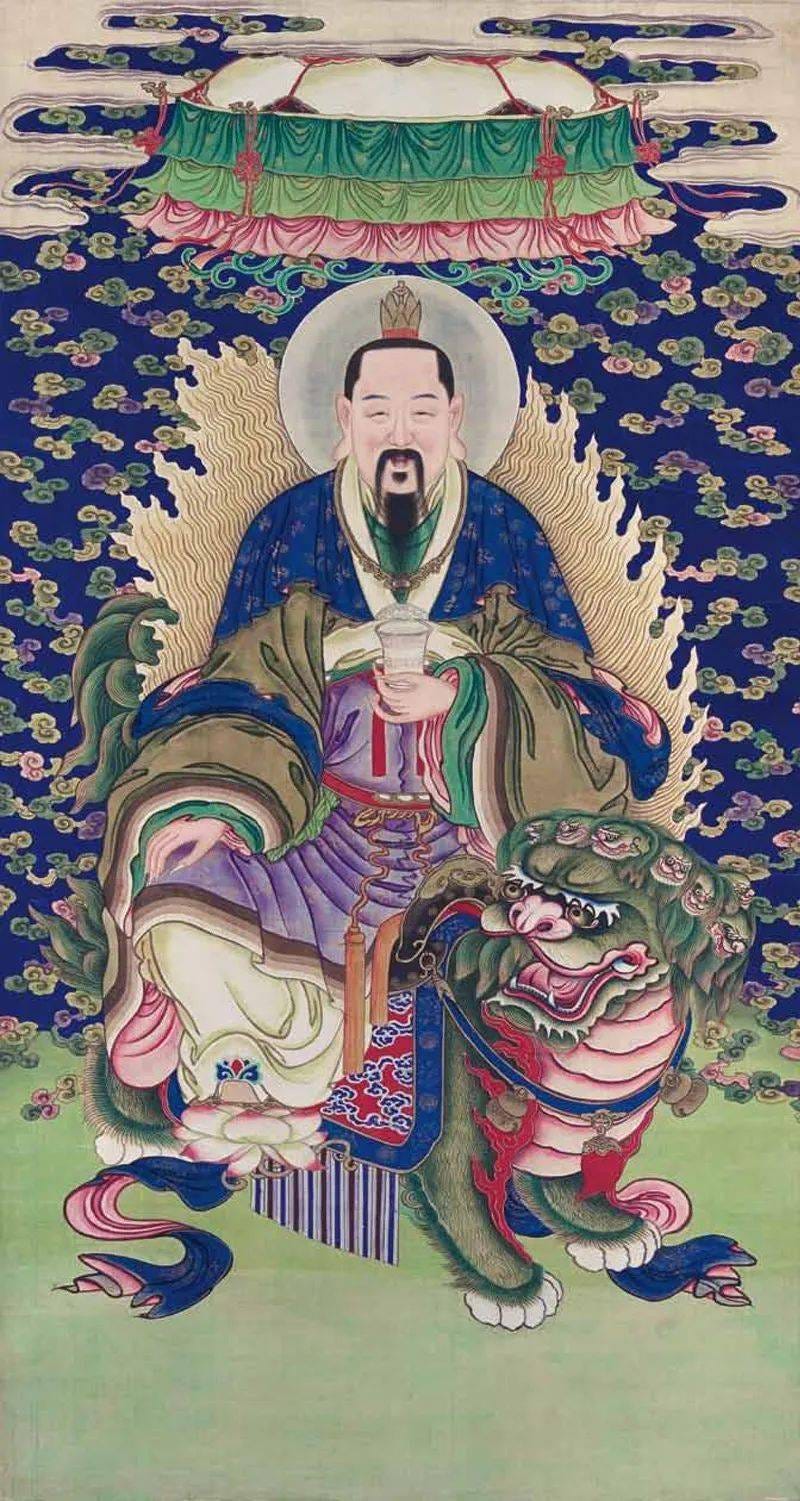
What is the shape? A savior defined entirely by hearing. Guanyin’s name is already an answer to the question of what compassion requires. She who perceives the sounds of the world (Guanshiyin). Taiyi is built the same way. The scripture does not describe him primarily by what he knows or what he has renounced, it describes him by his responsiveness, form after form, sand grain after sand grain, until the boy who will become the Celestial Worthy weeps in front of the assembled immortals and says out loud what we all know. In Heaven there is joy; on earth, calamity. That line is the theology. Everything which comes after it—the incantations, the promises of rescue from prison and flood and difficult childbirth, etc. is simply commentary on a figure who cannot stop listening to the sound of the world.
The ground laid by Chongxuan
Three centuries after that scripture likely took shape, a Daoist monk in Chang’an named Cheng Xuanying sat down to write a commentary on the Daode jing and made a decision that still resonates up to the present, he would read Laozi not as a historical sage who happened to write eighty-one chapters of advice, but as a compassionate universal savior—adopted openly from the Buddhist concept of the bodhisattva—whose entire textual output was an act of guidance offered out of limitless compassion for beings caught in the duality of being and non-being. A scripture written not begrudgingly after being asked by Yin Xi, the keeper of Hangu Pass, as the creation of the Daode Jing is often portrayed, but lovingly, out of compassion for the world. Friederike Assandri, whose translation of the Expository Commentary is the reason any of this is legible to us in English at all, is direct about what Cheng is doing. This is not incidental borrowing. It is the organizing idea of the whole commentary.
What strikes me, reading Cheng’s preface to that commentary, is that he gives Laozi a body theory almost identical in structure to the doctrine Buddhists use for the Buddha’s multiple bodies. There is a true body—the substance beneath appearance, described as an inconceivable union of essence, breath, and spirit (jing, qi, shen)—and there is a response body, which manifests differently depending entirely on who needs to be met and how. Cheng traces Laozi backward through a whole series of prior incarnations, teacher to legendary emperors across ages so old they precede ordinary chronology, appearing and dissolving according to need, never the same twice, because the beings who needed him were never the same twice. This body theory gets further elaborated within a generation or two into the three body structure it still holds, echoing the Trikaya, the three bodies of a Buddha.
Read that against the Taiyi jiuku hushen miaojing, written perhaps a century earlier or later and you have the same theological architecture doing two different kinds of work. The liturgical text gives you an archetypal savior who takes as many forms as there are grains of sand. The philosophical commentary gives you a Dao that manifests a different response body for every different capacity of student. Ritual and philosophy, working independently, converged on the identical solution to the identical problem. How do you make universal compassion actually universal, actually reach every single being in their particular circumstance, without diluting into abstraction? You give it infinite bodies. You make the very structure of the sacred responsive rather than fixed.
Cheng even tells us, in his own words, what a scripture is for, once you accept this premise. It is “a raft for all beings,” not a monument to be admired but a vehicle for getting people across. The teaching heals. The compassion is not a doctrine to hold but a medicine to take. All of these ideas will be familiar to Buddhist readers—the raft, the infinite bodies, and compassion at the heart of both the transformation of our own minds as well as how that is embodied in practice. Cheng’s specific genius was seeing how all of these ideas (as well as Chongxuan or Twofold Mystery, a Daoist twist on Madhyamika) could be found in the Daode Jing if you knew how to look.
Delivering all beings: the ancestors as method, not metaphor
It would be easy to stop here, treat this as a matter of high theology, and let the ancestors of my own lineage remain admirable but abstract. But Quanzhen was never built to let compassion stay theoretical. The tradition’s own architecture for cultivation—zhen gong, authentic inner work, and zhen xing, authentic outer conduct—makes compassionate action the necessary other half of realization, not an optional expression of it. A Complete Reality that stopped at inner stillness would not, by its own definition, be complete. The outer conduct half of that pairing is named directly in the tradition’s own accounts of the Seven Perfected: jishi duren—delivering all beings. Compassion is not the fruit of practice in this architecture. It is one of the two roots.
What makes this more than doctrine, though, is that the movement built around Wang’s teaching did not stay inside the hermitage. Under the chaos of the Mongol conquest, as the Jin state collapsed and famine followed the fighting across northern China, Quanzhen’s own organizational structure, an autonomous religious administration answerable to a single patriarch, thriving precisely because it stood outside the collapsing bureaucracy, allowed it to do something no isolated hermit could—raise funds on a nationwide scale for famine relief and for ransoming captives out of the war. That is compassion at the scale of logistics, not sentiment, by a community whose founding vision was supposedly about leaving the world behind.
Qiu Chuji, the same disciple who would later face down Chinggis Khan, had already practiced this smaller and closer to home. On the long westward journey to reach the Khan, accounts of his travels describe him doing what he could, town by town, to feed the destitute along the way before he ever reached the tent where he’d argue for sparing whole populations. The theology and the practice were the same motion at two different scales—a man handing out grain on a ruined road, the same man later persuading an emperor that Heaven disapproves of killing. Compassion, in this lineage, was never asked to choose between the intimate gesture and the geopolitical one. It was expected to show up at both. We can and should care for our neighbors, but we should also listen to the cries of suffering halfway around the world.
Wang Chongyang’s own surviving words are more austere than sentimental—his Fifteen Discourses spend most of their fifteen sections on breath, stillness, and the discipline of the solitary hut. But even there, compassion surfaces as a structural requirement rather than a feeling. On the question of choosing companions in the Dao, he writes that followers join together as companions precisely so they can assist each other in sickness and disease—if you die, I’ll bury you; if I die, you’ll bury me. It is a modest line, almost administrative, and that’s exactly what makes it useful here. This is compassion as a binding obligation between people who have chosen to depend on one another (one might even say, a social contract, as it were), not simply a quality or sentiment to be cultivated in isolation and only later, maybe, extended outward. The famine relief and the ransoms are that same small vow, scaled up to the size of a collapsing country.
This is the ancestor who founded lay congregations under the banner of Quanzhen and an ecumenical attitude, seeing the harmony of the Three Teachings, who taught that cultivation was never meant to end in a cave with the door sealed. It ends, if it ends anywhere, back out in the world that needed you in the first place.
A single word
Which is where Qiu Chuji comes in, not as a philosopher elaborating the doctrine, but as a walking embodiment of it. At seventy-one years old, crossing ten thousand li of Central Asian steppe, toward the one man on earth in 1220 capable of killing or stopping it, at continental scale.
Chingis Khan had summoned him for an elixir of immortality. Other rulers, he told Qiu when they finally met near the Amu Darya, had asked Qiu and been refused, and in fact Chinggis had previously asked Qiu more than once, if memory serves. Qiu had come across the span of an empire, and the Khan took it as an honor. He asked directly. Adept, what medicine of long life have you brought me from afar?
Qiu’s answer is the pivot we’ve been building toward, a “turning phrase” that echoes the Great Turning. I have means of protecting life, he said, but no elixir that will prolong it.
He had crossed a continent to say no to the thing he’d been asked for, and yes to something the Khan hadn’t thought to ask. What followed, by every account we have, filtered though they are through hagiography written after Qiu’s death by his own disciple, was not sorcery or alchemy as we usually think of it, but ethical instruction. What he told the Great Khan was that Heaven treasures life and disapproves of killing, that to rule well is to honor Heaven by loving the people under you rather than emptying the land of them. The Qianlong Emperor, writing more than five centuries after Qiu Chuji’s death, distilled the whole encounter into a single formal couplet, of the kind meant for inscription rather than casual praise.
Eternal life through the ages, no need to absorb the dawn’s radiance or seek secret teachings; with a single word he stopped the killing, and so we know his aid to the world held wondrous merit. 萬古長生,不用餐霞求秘訣;一言止殺,始知濟世有奇功.
The line does something specific rhetorically, it takes the very thing Chinggis Khan asked of him—an elixir, a “secret formula” for prolonging life—and declares that Qiu achieved something greater than that request without ever answering it. Immortality, in the emperor’s own retrospective judgment, turned out to have nothing to do with alchemy and everything to do with the sentence that ended a slaughter.
There is, in fact, a second and independent record of what Qiu actually said, and it’s worth looking at since it isn’t hagiography. On November 19, 1222, Qiu delivered a fuller teaching to the Khan, and this one was transcribed not by a devoted disciple but by Yeh-lü Ch’u-ts’ai, Chingiz’s own Khitan secretary, a court official with no religious stake in flattering a Daoist priest. Qiu grounds the teaching in the Dao as the source of Heaven and Earth, then tells a kind of fall narrative, that the first humans shone with their own radiant awareness until appetite and craving gradually dimmed that original light. His instruction to the most powerful man alive follows directly from the diagnosis. Those who study the Dao must learn not to desire what other men desire, must not live where other men live, must find their pleasure only in purity and quiet. And then, remarkably, he makes it personal and specific—he tells the Great Khan, to his face, that he has learned the Khan’s agents have been combing Beijing for women to fill his harem, and urges him to reconsider. (I can’t help hearing the echoes of own time and the Epstein Class.)
I don’t think it’s a stretch to hear that same diagnosis aimed at our own moment’s version of the man who could have anything and is still acquiring. The appetite Qiu is describing isn’t hunger in the ordinary sense, it’s the specific, ego-feeding craving that only grows by being fed, the kind that doesn’t stop at sufficiency because sufficiency was never the point. That is a fair description of what’s happening among the tech broligarchs now consolidating the largest concentrations of private wealth and infrastructural power in human history. These are not men meeting a need, but men who have long since exceeded any need and continue anyway, buying rockets and media platforms, and unprecedented access to the machinery of government itself, all while building doomsday bunkers, as if a part of them realizes they’re destroying the world, yet are unable to stop themselves, because the craving Qiu names doesn’t have an off switch built into its own logic. One can only come from outside, by a teacher, a tradition, or a society willing to say enough is enough. Qiu didn’t just diagnose the Khan’s appetite as a private failing to be managed through personal restraint, either. He immediately turned it into policy—remitted taxation, a competent administrator, relief for the provinces already broken by the fighting—because he understood that a ruler’s private craving and a population’s public suffering were the same problem seen from two sides. That’s the piece our own conversation about oligarchy keeps losing. The demand isn’t just that individually enormous men feel a private call to simplicity, but that the systems around them stop being built to reward the craving in the first place.
While this story is at least partly hagiographical, it is also testimony about a man crossing a continent to enter the tent of the most efficient killer in human history and speaking truth to power, as we might put it in today’s terms. But I find I don’t need it to be an official transcript for it to be true in the way that matters. Taiyi answers a cry. Cheng Xuanying’s Dao manifests a different response body for whatever the moment requires. Wang Chongyang’s ascetics kept their vow to bury each other and provide hunger relief even as the country burned around them. And Qiu Chuji, when the moment required it, became the response body. He walked the doctrine not just across China and Central Asia, but all the way from cosmology into a specific tent, in front of a specific man, and said what needed to be said.
The cry, now
I don’t think Jiuku Tianzun ranks the suffering he answers. The scripture doesn’t say he comes for the well-covered wars which fit our governments’ narratives (any government) and passes over the ones nobody is watching, which either don’t fit the narrative or are intentionally buried by various platforms. It says he takes as many forms as there are grains of sand, which is to say, no cry falls outside the count.
So, I will name some of what I hear this year, as testimony rather than argument, aware that on some of it reasonable people disagree. Be that as it may, the world’s experts and human rights bodies have largely converged on a verdict I have chosen to trust rather than relitigate myself: the killing in Gaza, which serious scholars of genocide, major human rights organizations, and several UN committees and special rapporteurs have concluded meets that word’s definition; the decades-long system of control and dispossession in the West Bank that the same bodies have named apartheid; a war against Iran entered by choice rather than necessity (Netanyahu finally finding a US president either sufficiently corrupt or sufficiently addle-minded to convince); Russia’s invasion of Ukraine grinding into its fifth year; and, in my own country, an administration turning the machinery of deportation into an instrument of open xenophobia and fascism—families separated, communities terrorized, cruelty treated as the point rather than the unfortunate cost.
And beside those, because Taiyi does not sort by headline: Sudan, where the largest displacement and hunger crisis on earth right now barely reaches most people’s attention, where whole towns have changed hands amid what independent monitors call a documented pattern of mass killing. Eastern Congo, occupied in all but name, millions displaced. Myanmar’s civil war, entering its sixth year under a junta that answers resistance with airstrikes on villages. Haiti’s capital, largely surrendered to armed groups while the state that might contest them has effectively dissolved. Yemen, still carrying one of the largest unmet humanitarian burdens in the world, mostly forgotten because it stopped being new.
I do not have a summons to the Khan’s tent. I do not have Qui’s opportunity to sit with a man who could stop the killing by deciding to. Most of us, most of the time, don’t. But the question his walk poses doesn’t require that we occupy his position to be bound by it. It only asks: what single utterance, spoken from the heart, where compassion actually lives, would stop this—and have I spoken it, or only heard the cry and let the hearing be enough?
I don’t have a clean way to close that question, and I’ve come to trust essays that don’t try. Jiuku Tianzun answers the cry, we’re told, by taking on a form fitted exactly to what’s needed, sand grain after sand grain, an answer for every particular grief. I cannot promise I know every form that is needed now, for Gaza or Sudan or the families being torn from their homes by my own government under cover of law. I only know the tradition I’ve inherited was never built to let me set that question down. Somewhere between the Great One who cannot stop listening and the old man who crossed a continent to say one true thing to a killer, there is a discipline being handed to me that I have not yet fully practiced. Raise your voice and it will be answered. But first—the raising.
Gregory, what a beautiful piece of writing. From Taiyi Jiuku Tianzun to Ancestor Qiu, and even Laozi himself, compassion at the heart of the tradition. This is the reality of the tradition that so many people in the west don't know or don't care to find out, bemusing themselves with an imagined "just let it flow" rhetoric which was never what the tradition actually said.
There have been serious studies quantifying just how much killing did stop after Ancestor Qiu's visit to Chingghis Khan -- how he stopped the expansion of one campaign. Ancestor Qiu emphasised the 'wei'- action - in 'wuwei', effortless action, and organised food relief and support for the starving in Shandong after the Jurchen invasion.
Compassion was always at the heart of it. thank you for this wonderful explanation. 🙏